
The Science Behind BioFit
20 Minutes.
More Results Than
Hours of Gym Work.
This isn't a marketing claim. It's the conclusion of decades of peer-reviewed research on High-Intensity Training, adaptive resistance technology, and the physiology of muscle adaptation. Here's the science.
The Problem
Why Conventional Exercise Fails Most People Over 50
Starting around age 30, the human body loses 3–5% of its muscle mass per decade — a process called sarcopenia. After 50, this accelerates. By 70, the average person has lost 30–40% of the muscle they had at their peak.
This is not just about how you look. Muscle is metabolically active tissue. As it declines, so does your resting metabolic rate, your insulin sensitivity, your bone density, your balance, and your ability to do the things you love — independently.
The conventional answer — "go to the gym more" — creates its own problem. High-impact cardio classes carry real injury risk for people with reduced bone density or worn joints. Traditional weight training requires learning complex movements and risks overloading joints. And most programs demand 4–5 days per week, which most people simply don't sustain.
A 2024 report from the American Academy of Orthopaedic Surgeons documented a 67% increase in sports-related injuries in adults 65+ between 2012 and 2021. Research from Massachusetts General Hospital found that 46.5% of advanced HIIT practitioners reported injuries — shoulder, lower back, and knees most common.
The question isn't whether to do resistance training. The research is unambiguous that it's essential. The question is: which kind produces the best results with the lowest injury risk?
The Sarcopenia Timeline
Source: American College of Sports Medicine
What Muscle Loss Actually Costs You
The Mechanism
Why 20 Minutes Beats 90 Minutes.
The Physiology Explained.
High-Intensity Training (HIT) — not to be confused with HIIT cardio intervals — is built on a single physiological principle: momentary muscular failure.
When a muscle is taken to the point where it cannot complete another rep with good form, it recruits every available motor unit — including the high-threshold fast-twitch fibers that moderate-intensity exercise never reaches. These fibers have the highest capacity for growth and strength development. Conventional gym training at comfortable weights simply doesn't touch them.
Dr. Doug McGuff's research, published in Body by Science, demonstrated that brief, infrequent, high-intensity sessions — with 4–7 days of recovery between them — consistently outperform higher-frequency, lower-intensity programs for muscle development, strength, metabolic improvement, and cardiovascular conditioning.
The recovery window is not a limitation. It is the mechanism. The workout is the signal. Recovery is where the strength is built. Training again before that process completes doesn't accelerate results — it interrupts them.
In a study commissioned by the American Council on Exercise, participants following a HIT protocol gained an average of 12.4 lbs of muscle and lost 17.1 lbs of fat in 14 weeks — without changing their diet.
HIT vs. Conventional Training

The Time Equation: Why Less Is More
The Evidence
How ARX Adaptive Resistance Technology
Makes Every Rep Count
Traditional resistance training uses fixed weights. The problem: your strength varies dramatically throughout a movement. At the bottom of a bicep curl, you can lift far less than at the midpoint. A fixed weight is either too light at your strongest point or dangerously heavy at your weakest — meaning most of the range of motion is suboptimal.
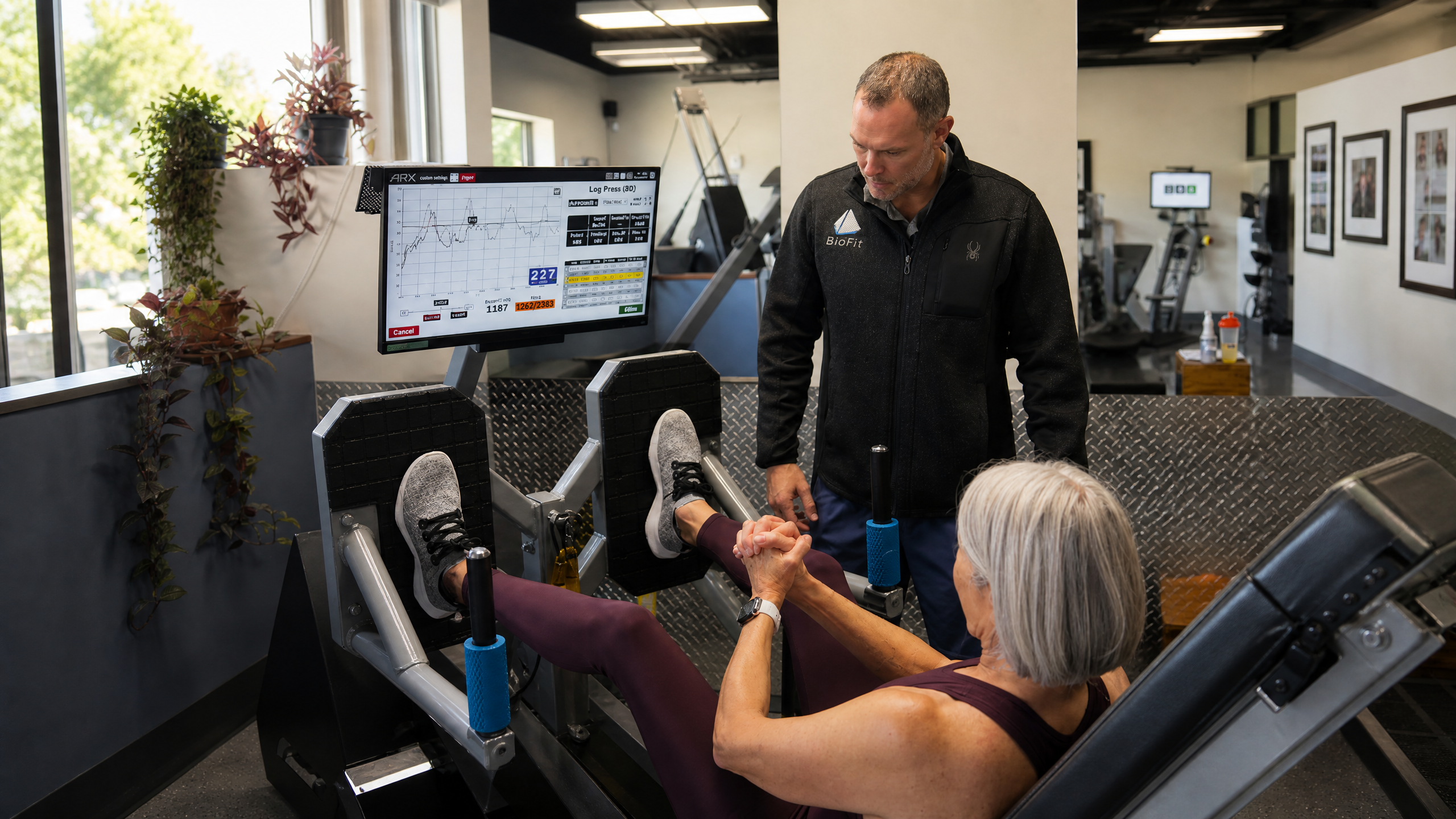
The ARX (Adaptive Resistance Exercise) machine solves this with a motor-driven resistance that responds in real time to the force you apply. At every point in the movement, the resistance matches your output exactly — maximizing the training stimulus throughout the full range of motion.
Critically, ARX also provides controlled eccentric resistance — the lowering phase. Research consistently shows the eccentric phase produces more muscle protein synthesis than the concentric (lifting) phase. With free weights, the eccentric is limited by what you can lift. With ARX, the motor can provide greater eccentric resistance than concentric, unlocking a training stimulus simply not achievable with conventional weights.
Every rep is recorded. Force output, range of motion, and time under tension are displayed in real time — giving your coach precise data to optimize your program, and giving you objective proof of your progress. You don't have to guess whether you're getting stronger. The machine tells you.
Why ARX Changes Everything for Adults Over 50
ACE-Commissioned Study
"12.4 lbs of muscle. 17.1 lbs of fat. 14 weeks. No diet changes."
In a study commissioned by the American Council on Exercise, participants following a High-Intensity Training protocol achieved these results in just 14 weeks — training twice per week, without any dietary intervention. These are not outlier results. They are what happens when the right training stimulus is applied with the right recovery window.
Bone Health & Safety
The Exercise That Builds Bone
Without Breaking It
Bone is living tissue. It responds to mechanical stress by becoming denser and stronger — a principle known as Wolff's Law. When muscles contract forcefully against resistance, they pull on the bones they're attached to. The bone responds by depositing new mineral content along the lines of stress.
This is why resistance training is consistently rated by orthopedic and endocrinological societies as the most effective non-pharmacological intervention for osteoporosis and low bone density. Walking, swimming, and cycling — while valuable for cardiovascular health — do not produce the mechanical loading necessary to stimulate bone remodeling.
The Mayo Clinic specifically recommends avoiding high-impact activities for people with osteoporosis, as these can lead to fractures in weakened bones. HIT on the ARX provides the bone-stimulating mechanical load without the impact risk — making it the clinically appropriate choice for this population.
With consistent resistance training, adults can gain 1–3% bone density per year — reversing the 1–2% annual loss that occurs post-menopause without intervention.
Exercise & Bone Health: What the Evidence Shows
Sources: Mayo Clinic, National Osteoporosis Foundation, ACSM
Injury Risk: What the Research Shows
A 2024 AAOS report found a 67% increase in sports injuries in adults 65+ between 2012 and 2021, coinciding with the rise of high-intensity group fitness classes. Research from Massachusetts General Hospital found 46.5% of advanced HIIT practitioners reported injuries.
HIT on the ARX addresses this directly. The motor-controlled resistance cannot exceed what your body can safely handle. There is no momentum, no dropping weights, and no ballistic movement. The eccentric phase is controlled at all times.
Note: This section presents research on injury patterns in various exercise modalities. It is not a claim that any specific program is dangerous. Individual risk depends on fitness level, existing conditions, and how exercise is performed. Always consult your healthcare provider before starting any new exercise program.
Sources
Citations & References
American College of Sports Medicine. Position Stand: Exercise and Physical Activity for Older Adults. Medicine & Science in Sports & Exercise, 2009.
McGuff, Doug & Little, John. Body by Science: A Research Based Program to Get the Results You Want in 12 Minutes a Week. McGraw-Hill, 2009.
American Academy of Orthopaedic Surgeons. Sports Injuries in Older Adults Report, 2024. 67% increase in sports-related injuries in adults 65+ between 2012–2021.
Massachusetts General Hospital / Harvard Medical School. HIIT Injury Prevalence Study. 46.5% of advanced HIIT practitioners reported injuries (shoulder, lower back, knee most common).
Mayo Clinic. Osteoporosis and Exercise: What You Need to Know. Recommends avoiding high-impact activities for people with osteoporosis.
National Osteoporosis Foundation. Bone Health Basics. 54 million Americans affected by osteoporosis or low bone mass; 1–2% bone density loss per year post-menopause.
American Council on Exercise (ACE). High-Intensity Training Study. Average 12.4 lbs muscle gained and 17.1 lbs fat lost in 14-week HIT protocol.
ARX Fit. Why Adaptive Resistance: The Science Behind Motor-Controlled Resistance Training.
Wolff, Julius. The Law of Bone Remodeling (Das Gesetz der Transformation der Knochen). 1892. Foundational principle: bone adapts its structure in response to mechanical loading.
* This page is for informational purposes only and does not constitute medical advice. Please consult your healthcare provider before beginning any new exercise program.
Ready to Experience It?
The research is compelling.
The results are real.
Come experience 20 minutes of science-backed training for yourself. Your first session is completely free. No commitment. No sales pressure.
Book My Free Session →Richmond Heights · Fenton · 314-339-6250